Yellowstone and more

It took only 2 hours to replace the windshield.  It’s odd to be able to see through clear glass instead of thousands of smashed bugs! After leaving Helena we drove through Livingstone, MT and off Rte. 89 into Mallards Rest, a fishing access road on the Yellowstone River.  This 671 mile river is the longest one in the US that is undammed, flowing unobstructed from its headwaters in Montana to the Missouri River.  The road to the camping area was very steep and rocky, but the van came through for us once again.  We spent a quiet night and set off to find a dump station before going into the park. Found one in the KOA just across the river and ran into an employee who was from Staten Island! Part of the West Brighton Peterson family, grew up in Sunnyside and currently lives in Long Beach with his girlfriend and their dog.  He works summers here and winters in another KOA in Florida.


Got to Mammoth (at the north entrance to the park) and it was packed.  Cars, RVs, people walking every which way. Along with many other tourists, we watched a full grown elk buck chasing a spike horn behind the employee resident buildings – remnants of Fort Yellowstone. Must be the start of mating season.  I thought this was the off season but not so much. It was almost impossible to find a camp site in the park but I managed to snag one of the last two in Canyon CG. We ate at the Canyon Village and booked a bus tour for the next morning.

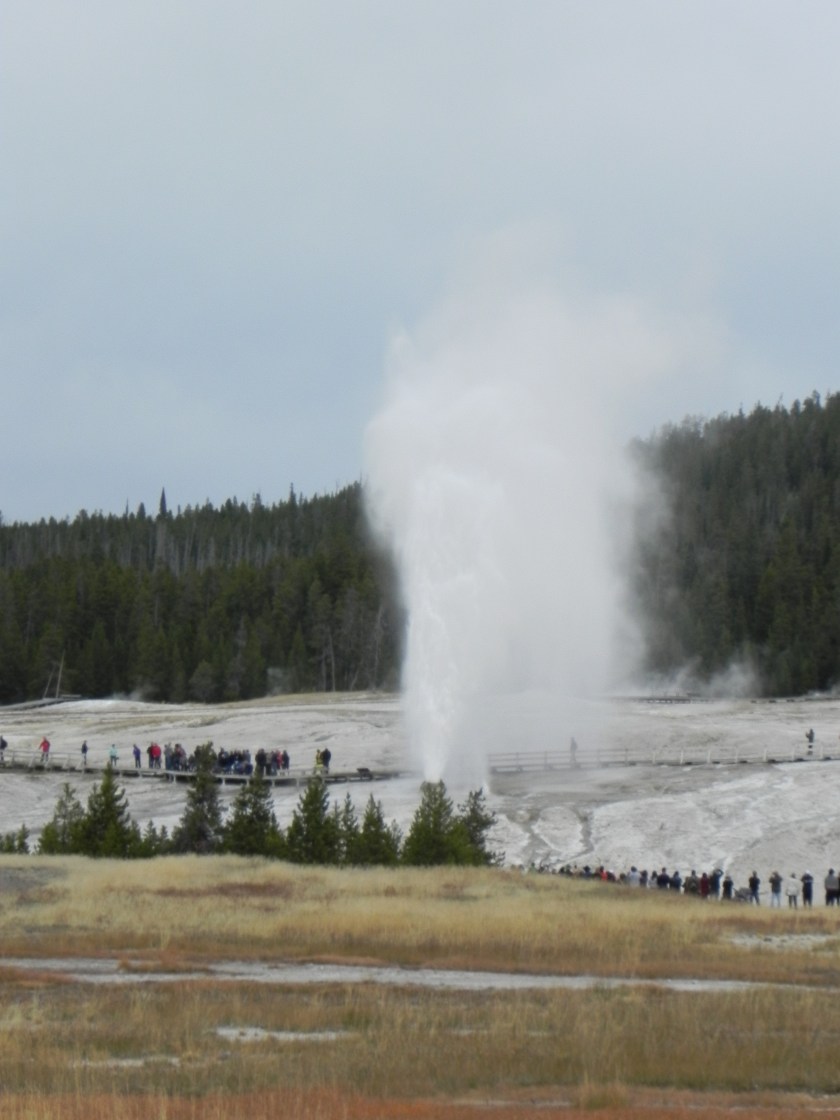
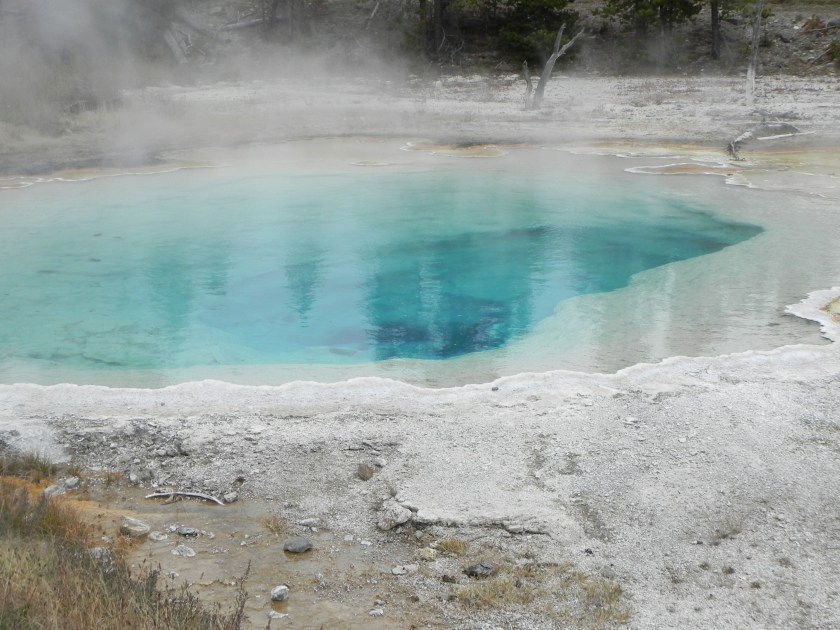
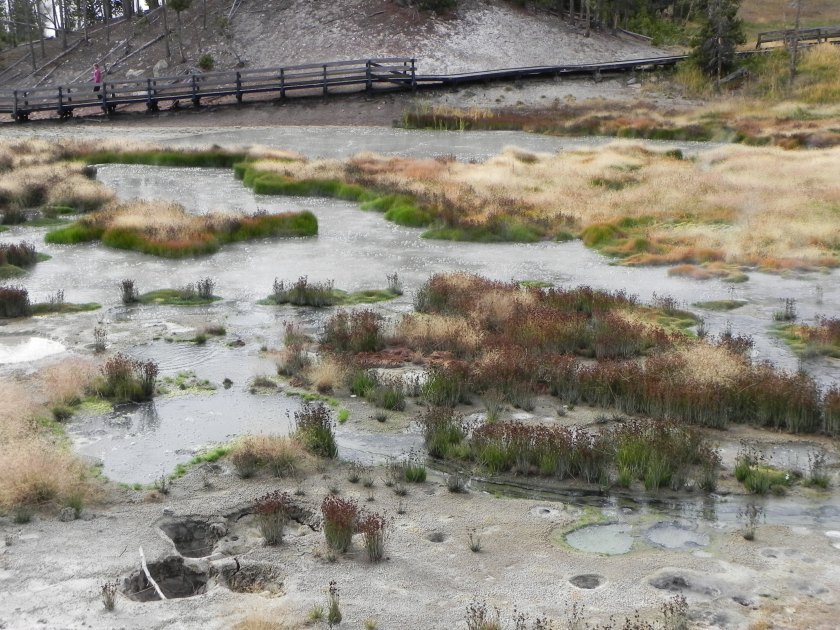
The tour, while not as intimate as the Red Bus at Glacier, was interesting and hit all the hot spots in what is known as the “ring of fire”.  In addition to Old Faithful, we saw the Beehive geyser erupting, in many ways more impressive than Faithful – higher and longer. Just as predictable but it only spouts once a day during daylight hours.  Other sights included the Fountain Painted Pots (hot springs and mud pots), midway and lower geyser basins with bubbling pools and constantly spouting mini-geysers, bacteria mats and prismatic pools.

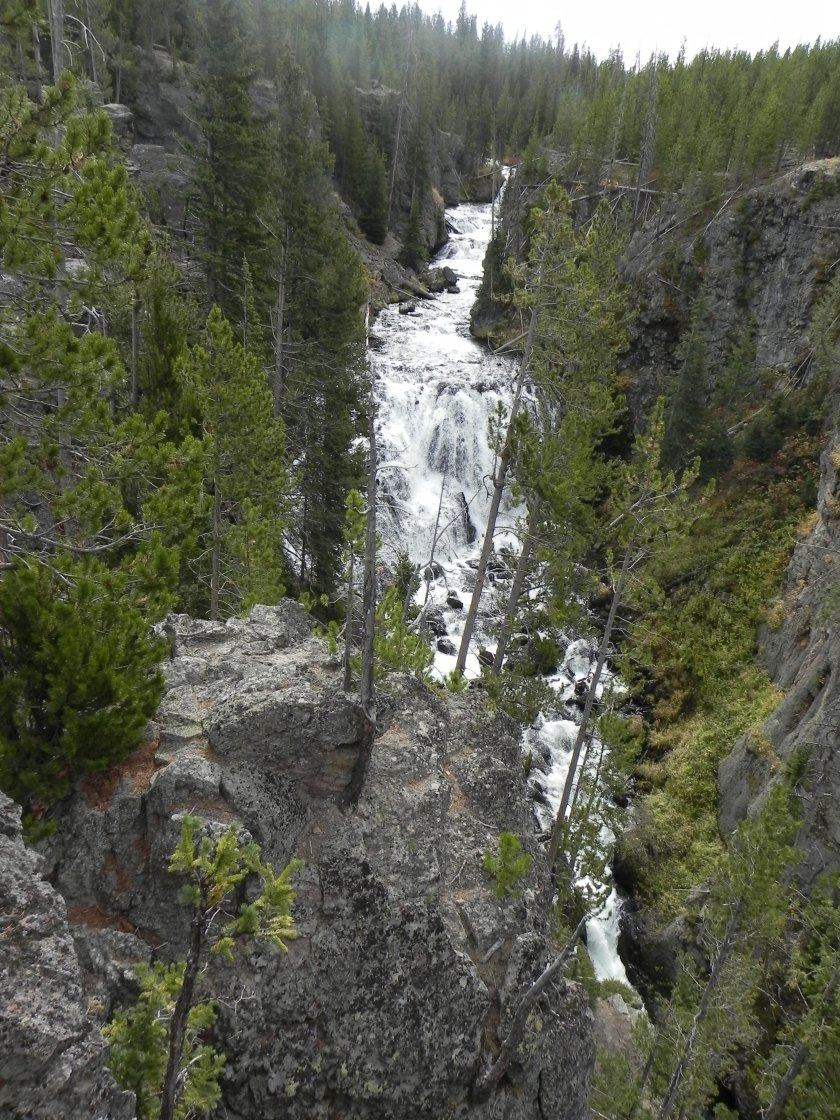
We drove through Hayden Valley and saw a few bison, one of which stomped and seemed to challenge our bus as it passed by.  In Lake Yellowstone we saw Goldeneyes (probably Barrows) and the ubiquitous ravens.  The tour also stopped at several waterfalls and cascades before returning us to the Canyon Village at about 4:30. We ate dinner and booked a site at Madison CG, again one of the only two sites left.  Drove to Madison and tucked in for the night.
DSCN1921DSCN1946DSCN1957

DSCN1934

The next day we took off for Grand Teton NP, skipping the mass flight to Norris to see Steamboat Geyser erupt, an occasional and unpredictable occurrence but bound to be packed with cars and RVS.  Had enough of that! We stopped at the first campgrounds outside the park (and before Teton), the Flagg Ranch CG and lodge.  The heater seemed to run most of the night and when we awoke we discovered why.  The temperature outside registered 19° F, a record low for this trip. Even the dishwashing faucet at the rest room was frozen shut.

We drove another 100 miles and had lunch at the Pothole turnout.  Potholes, also known as kettles, were formed by pieces of retreating glacier left behind, which then melted and formed depressions 15 feet to ¼ mile wide acting as an oasis in the middle of the grasslands. The one near the turnout was about 200 feet rim to rim; this area is full of potholes, many clearly visible from the road as we drove to Jackson.

On the way out of the park we stopped at the Wildlife Museum and spent an enjoyable couple of hours among the paintings, drawing and (especially) bronzes on display.  Not only were local artists represented but painters and sculptors from around the world. Most impressive were the outdoor bronzes depicting the elk, bison, wolves and moose found in this area.

Spent the night at the Mountain Modern Hotel in downtown Jackson, catching up on laundry, showers and wifi. After walking around town for a couple of hours, we were on our way. But we didn’t get too far; pulled up about ½ mile out to stop outside the National Elk Refuge, along a small river.  There were several Trumpeter Swans on a nest, coots, ring-neck ducks, pied billed grebes and mallards feeding.

We continued on our way, turning east towards DuBois on our way to Colorado and decided to stop at Falls CG in the Shoshone NF for lunch.  The campgrounds were pretty and quiet so we found a site for the night, just a few hundred yards from the falls.


Glacier or bust


As we started to pack the van Thursday night for  for an early Friday am departure, we found we had absolutely no coach power – no lights, no fridge, no nothing. Drove back to La Mesa RV the next morning and by the time we walked to Starbucks and back, Skip had jumped the inverter battery and we were back in business. We wanted to drive straight to Glacier – about 1300 miles – so we were glad the fix was an easy one. But the malevolent  van gods were not through with us.  Just as we were getting up to speed on I 17 outside of Phoenix we caught a road bullet, kicked up by a truck and putting a neat hole in the windshield.

Drove 303 miles (8 hours) to Lake Powell just before the Utah border and stayed overnight at Lone Rock campgrounds, a primitive site on the lake shore.  Highlight: a couple of jack rabbits hopped right past our van.  We left at 6:40 the next morning and drove up to Kanab, had breakfast and headed to Zion NP, one of our target parks.

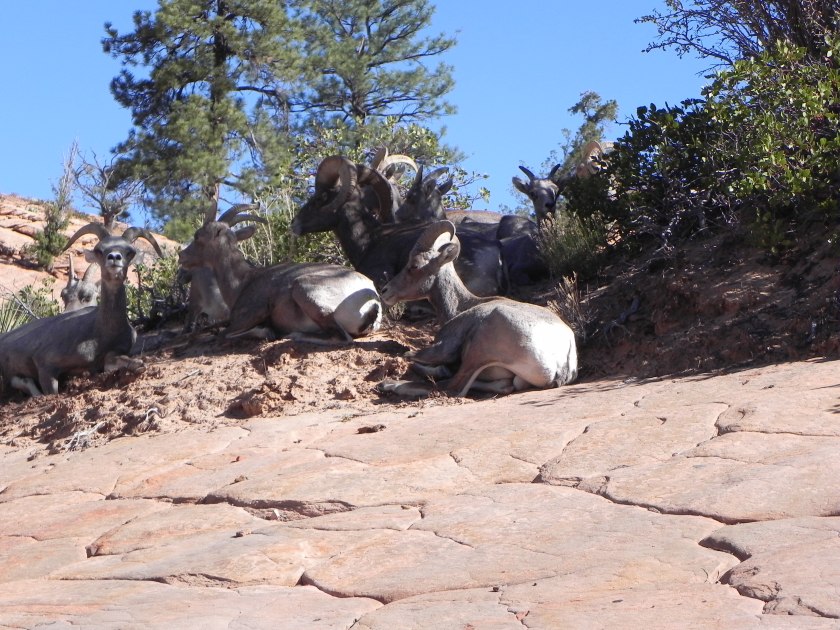
When we first entered Zion, cars were stopped to look at a herd of big horn sheep crossing the road, so naturally we stopped, too, to take a couple of pictures.  After a slight mishap in the tunnel (Ron couldn’t find the light switch.  It was darker than dark…) we continued on the park road.  Just an aside: one of the reasons we decided to visit these parks in September was to miss the summer crowds.  Not so much.  Every pull out was overflowing with cars, all the lots were full and people were everywhere. Disappointed, we drove right through and continued on our way. Maybe we’ll try again on the way back from Colorado.  We found a campground that night  by Yuba Lake SP, where the wind was gusting over 30mph and kicking up salt from the lake shore.

DSCN1742

Driving was great on Sunday – few cars and almost no trucks – even through the heart of Salt Lake City, so we decided we could take a break. We found a wildlife area, the Bear Creek Migratory Bird Refuge, just outside of Brigham City, and spent a couple of hours following the auto road around fresh and salt water ponds.  We saw Clarks, western and pied billed grebes, avocets (including two chicks resting on the shore while mama foraged nearby), cliff and barn swallows and Caspian and Fosters terns. Stopped at Walmart, filled the tank (again!!) and found a campgrounds at Scout Mountain in the Caribou NF in Idaho).

DSCN1757
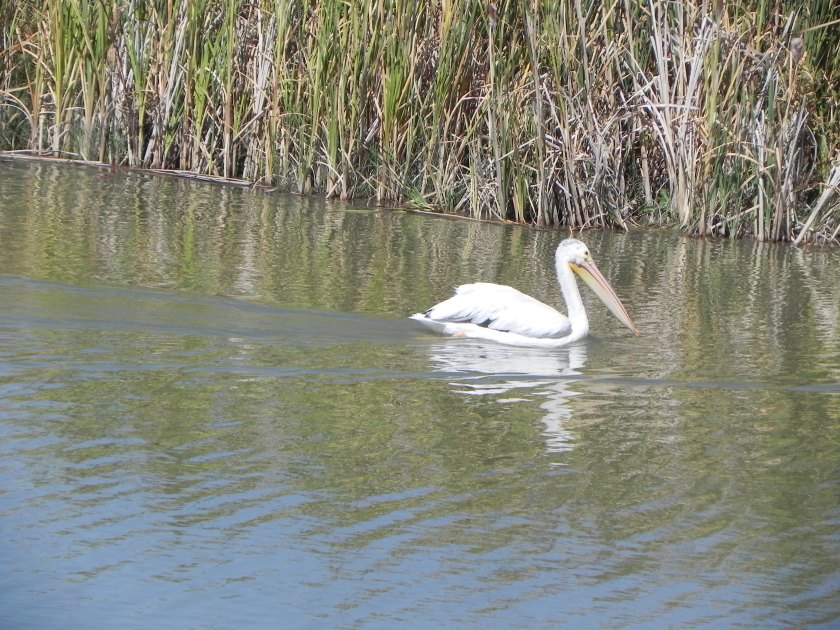
A white pelican cruising along in Bear Creek NWR

Monday was a long drive day (320 miles) , only stopping for food and gas – twice. We spent the night at an abandoned campgrounds in Deerlodge NF, just outside of Butte, Montana.  When we woke the next morning, it was 26 degrees and our windshield ding had become a long, long crack. Decided it needed to be taken care of asap, so we left early and called Hartford, only to find the deductible for glass was $500, more than the cost of a replacement.  They connected us to Speedy Glass in Helena and we found our way there with no trouble, but Ron, the manager, generously recommended we go to Safelight to take advantage of their nationwide warrantee.  Safelight assured us that is was safe to drive so they will order the glass and we can return Friday on our way to Yellowstone to have it installed.

Continued on our way, stopped in Choteau for lunch and gas (yes, again. These 80 mph speed limits and mountains are killing our average mileage!) then continued on Rte 89 to the park.  There is quite a lot of road work being done on Rte 89.  Twice we had to wait for a pilot car to lead us safely through the construction zones, over dirt and rock for miles.  We finally reached St. Mary’s on the east side of the park, only to find all the inns and hotels closed for the season, prematurely because of the recent fires.  Wound up at the KOA for the night, postponing showers but able to do all our laundry. Coincidentally, the Roadtrek 190 parked on the next site was from New Jersey. We met the owners the following morning and chatted for a while, ran into them again on the shuttle bus later that day.

DSCN1771
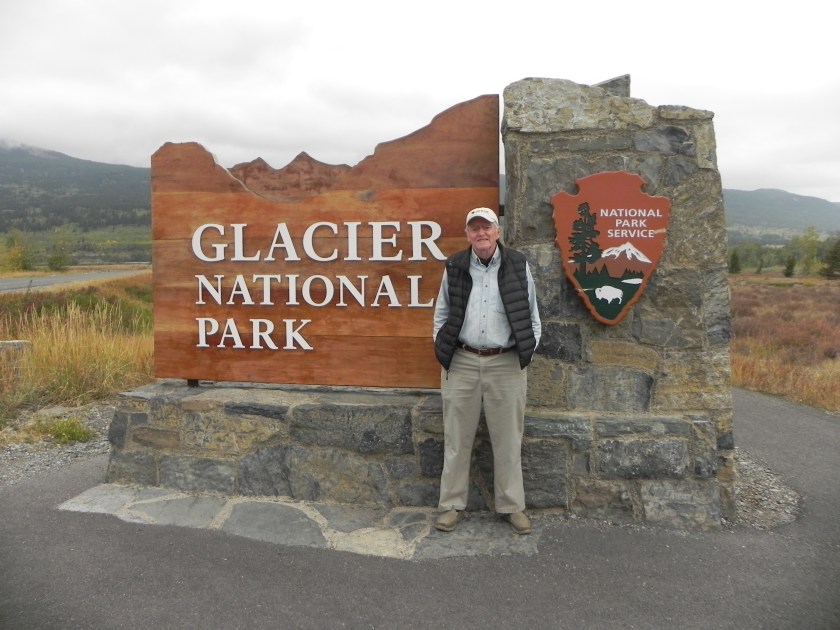
Ron gets to check this one off the bucket list.

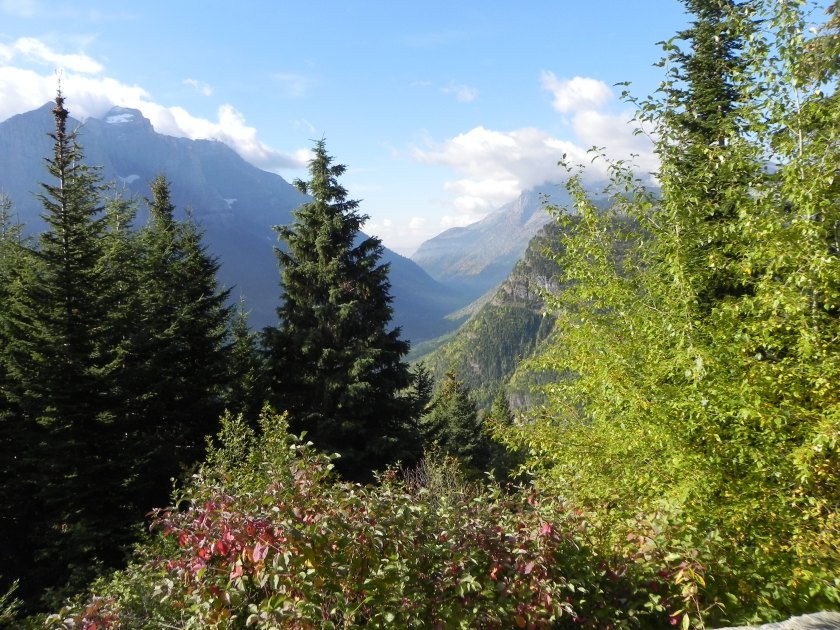
The trip up to Logan Pass was scenic despite the cloudy, drizzly weather.  We did spy the Jackson Glacier from the bus windows.  Learned a bit about Glaciers at the visitors center; although the park was named because the physical environment was formed by glacial activity, there were still 150 identifiable glaciers when the area was first explored at the close of the 19th century.  That dwindled to fewer than a dozen today and there will probably be none by 2030. When the shuttle ride was done, we booked a room on the other side of the park at the Apgar Village Inn right on the shore of McDonald Lake and planned to take a Red Bus tour the next day.

DSCN1846

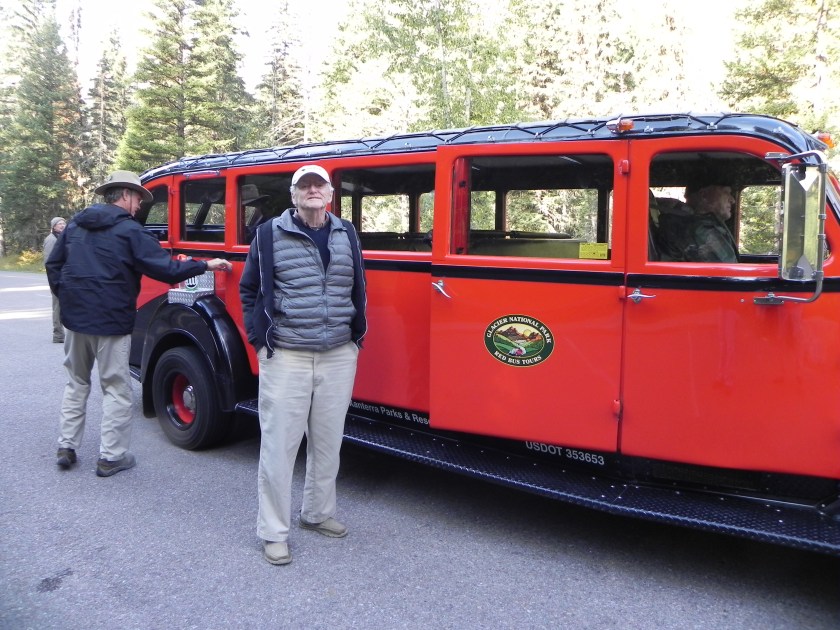
Luckily, the weather had cleared when we woke up although it was only in the mid-30s as we waited for the bus to come. The 17 passenger Red Buses have been transporting visitors in Glacier since the 1930s, traveling from the Village to Logan Pass on the west side of the park.  Our guide, JC, knew a lot about the history and geology of the area and shared his knowledge generously throughout the tour. Surprise, surprise. Also on the tour were two retired women from Staten Island, one from St. George who had taught at IS 27 for many years, the other from Tottenville who had taught briefly at Curtis. Small world, indeed.

DSCN1840
The Red Buses of Glacier NP

We left the park at about 2:00 pm and headed back to Helena to have the windshield fixed.  Camped in the Lolo National Forest in the Lake Alva campgrounds.  Although there are 39 sites in this 30 acre park, there are only two other campers here.


The Ultimate Road Trip, Part 2

So, not at all sure we were up to doing this again, we boarded Southwest flight 4473 and headed to Phoenix to rescue the van from its storage unit and begin part two of our quest to see as much as possible of the western USA. Doug picked us up from the airport and we settled back into his guest house for a couple of days. I can’t minimize how important Doug has been to the success of our trip, offering room and board, transportation and travel advice that we could not possibly have gotten elsewhere. Ever grateful, Doug.

Of course the battery was dead when we got into the van but Roadtrek roadside assistance came through and sent us Andy of All in 1 to jump start it.  It was much, much easier getting the Zioness out of the unit than it was putting it in.  Just a few maneuvers and we were on our way to Mesa RV to get our oil changed and a new battery, then out to a long awaited brunch.  Now that we’ve been in the van and started planning  the next leg of the trip seems as exciting as the last.  Glacier Park, here we come!

Winding down the Ultimate Road Trip

With only a few days left before returning to Phoenix we headed south to the city of Show Low to find an inexpensive motel for showers and laundry.  The KC Motel on Deuce of Clubs Street seemed to fill the bill. Curious about both name of the town and the name of the main street, we checked wikipedia to find an answer. Turns out, according to legend, there were two homesteaders in the early days that felt the town wasn’t big enough for both of them (such a western concept) so rather than settling their disagreements with guns they decided to draw from a deck of cards.  They agreed that whoever drew the lowest card – or show low –  could stay, the other had to pack up and leave.  The story goes that one of them turned over the deuce of clubs and remained to name the town, and its main thoroughfare, in honor of his good luck.  Who knows if it’s true but it certainly makes a good tale. And what else could explain the names?

We left Show Low for the Apache-Sitgreaves NF and some inexpensive camping and on the way saw a couple selling indian fry bread by the side of the road.  Naturally, we turned around to buy some and met the vendors Larry and Sue, he Apache and she a Navajo, who are getting married next week.  He has a sister who lives in Long Island so we invited them to visit when they go up north to see her. Left them a card with our contact info.

We spent the night in Benny Creek CG,  totally alone until one other car pulled in across the campground while we were out for a walk and set up their tent. We did a little birding along the Bunch Reservoir and saw a few spotted sandpipers, a killdeer, many western bluebirds, chipping sparrows and the elusive Grace’s Warbler. The following night we found ourselves alone again in the Timber CG in the Tonto NF.  It’s really peaceful being alone in the woods, despite being only a few hundred yards from a main road.

Ron found an interesting sounding campgrounds in our guide (also in Tonto NF) near a town called Tortilla Flats along a scenic mountain road called the Apache trail. We stopped at the Tonto National Monument to fill a jug of water and to get our passport stamped.  We’re running out of room on the western pages!  Took a pass on climbing to the cliff dwelling, though. It was way too hot so we opted to watch the movie at the visitors’ center instead.  I think we may be getting sated with native American ruins.

We took the scenic route to our next stop, following Lake Roosevelt to the Theodore Roosevelt dam on the Salt River. A word of advice; when the sign says “Pavement Ends” turn around and go back to find an alternate route. Ron spent the next few hours white-knuckling along an unpaved, steep, winding, un-guard railed, washboard road on what is known as the Apache Trail.  The Apaches did not drive camper vans with 16″ tires and low clearance, filled with rattling dishes and silverware, with cabinets and drawers that inconveniently pop open in the narrowest of stretches.  Up side is that it was breathtakingly beautiful.

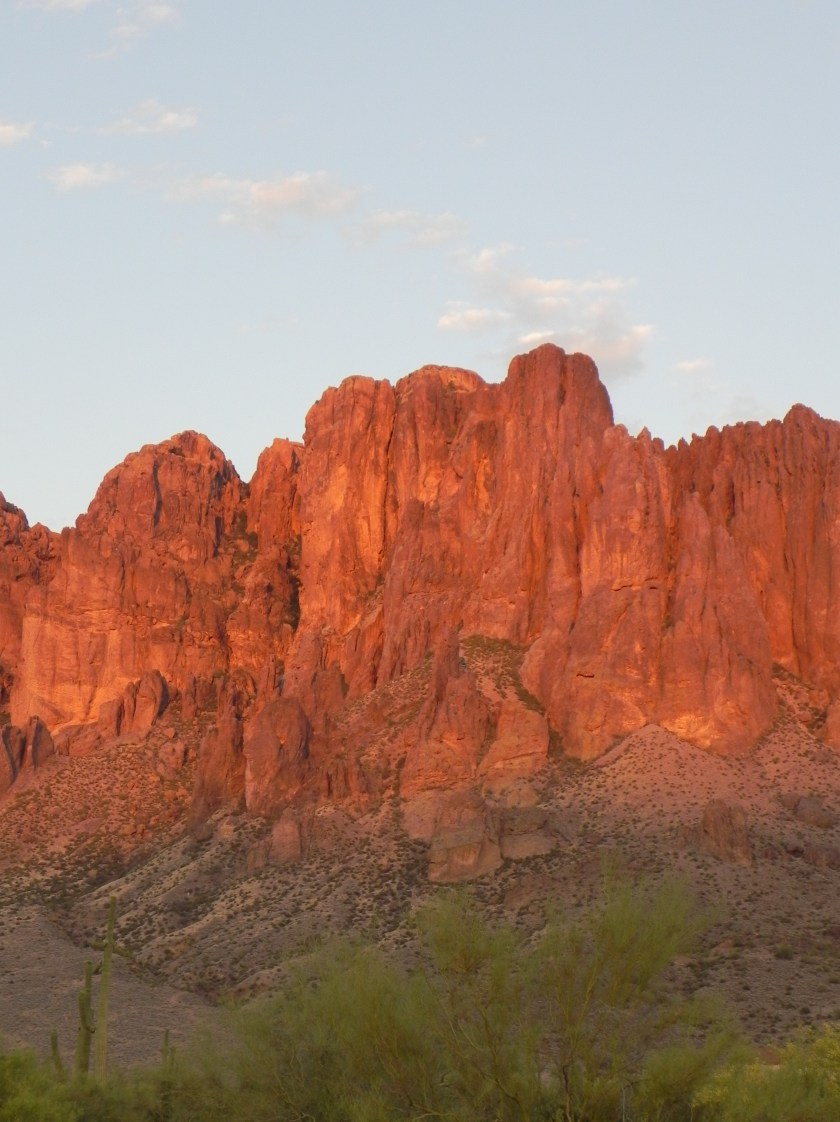
When we finally got to Tortilla Flats the campground we sought was closed for renovations so we continued down the mountains – on a paved road this time – to the Lost Dutchman’s State Park for our last night of camping. We sprang for a site with electricity and water, not to mention real flush toilets a few sites away.  It was hot, over 99 degrees at dusk, but we ate the last of our dinners at the picnic bench and watched the sunset turn the Superstition mountains red.  Phoenix is less than 50 miles away and the next day we head for Doug’s once more to prepare the van for storage and pack for our flight home, but not before making one more stop at an old mining town, complete with abandoned equipment, a zip line (no, didn’t do it), a famous saloon, lots of trinket shops and a bakery/coffee shop –  our real reason for stopping.

DSCN1717
Sunset in the Superstition Mountains

We spent the next couple of days relaxing in Phoenix, eating out and making final plans for leaving the van for the summer and having it serviced when we get back in September. We had a short, pleasant visit with Joe McLaren and Charlie and Judy Zarelli in Scottsdale and finally got the van washed.

Doug’s hospitality was over and above, as it has been our entire visit. He even got us to the airport for a 6:05 flight to Newark!

It wasn’t easy, but the Zioness is safely sleeping in her summer den.  We’ll be back on the road right after Labor Day – more adventures await!


Homol’ovi and the Petrified Forest

After leaving the snow covered campground behind, we retraced our route through the San Franciscan Peaks – mountain range right outside of Flagstaff – and headed east for our last few days of camping. There was another park en route to the petrified forest and painted desert with more native American ruins we decided to visit.  This ancient (abandoned) pueblo is part of an ongoing research partnership between national parks and the Hopi tribe, investigating the lives of the Homol’ovi, a nomadic people whom the Hopi consider their ancestors.  Bought a book of Hopi oral history and legends to try to piece this all together when I get home. The wild (actually feral; they left the reservation years ago and live on the open range alongside grazing cattle) burros below crossed the road in front of us on our way back to the campsite.  The horned lizard crossed the footpath on the way to Homol’ovi II, one  of the dig sites.

We stayed for two nights and drove to the Petrified Forest NP.  Took the easy way and did most of the sights from the 20 mile drive through the park, only stopping now and again to take some photos.

Grand Canyon: the adventure continues

We pulled into Mather CG in the Grand Canyon National Park at around 3:00 Sunday after boondocking for two days off FR3 in Coconino National Forest, just north of Mormon Lake.  We pretty much stayed close to “home” for both days except for a really good lunch at the restaurant in Mormon Lake, which also housed the Zane Grey museum.  There were movie poster and book cover replicas hung along with lots of taxidermy – elk, deer, badger, even a cougar or two. We get it that this is a hunting destination; probably used to be a fishing destination as well but Mormon Lake has been reduced to a couple of puddles.  A sign in the restaurant said “Save your boat and oars, boys, the lake will rise again”.

The ride was uneventful except for a stop at Kendrick Park wildlife trail where we birded for a couple of hours, catching sight of mountain chickadees, pygmy nuthatches and a female Western bluebird, all of which we saw again at our Fir loop campsite at the canyon.

Once we checked into the campground we took a shuttle bus around the park to get the lay of the land and to make reservations at El Tavor, an upscale lodge and restaurant that Ron had eaten at with Doug on his first trip here a few years back. I also got my first glimpse at the canyon itself, with the waning light bouncing off the ledges and creating deep shadows among the cliffsides. Majestic, indeed.

On Tuesday we boarded the bus again, transferred to the Red Line which followed the rim trail for about 9 miles.  I decided to walk the last mile so I could walk along the rim for a bit, leaving Ron to take the bus to Hermit’s End where we met about an hour later.  It was somewhat cold and windy but the views were fantastic with many sights of the river and rapids below.

Woke early Wednesday morning to some strange sounds coming from outside the van.  It wasn’t until we lifted the back door curtain that we found out where the sound was coming from – a wet snow had fallen overnight and was dropping from the Ponderosa pines onto our roof. Four inches had accumulated, transforming  the campground into an unexpected wintry wonderland – in May!


Sedona

We arrived at the condo about five minutes after Jan and Charlie did.  Spent a quiet evening and ate BBQ at Hog Wild in Cottonwood. Gai and Gary were supposed to park their motor home nearby but Gary hurt his leg unhitching their tow car and wound up having surgery and camping in Williams, the “gateway to the Grand Canyon” over 50 miles away. Gai did drive down to visit twice during the week  and we drove up to hang with them in their spacious (and luxurious!) RV once.  Highlights of the week included:

  • Visited Tuzigoot National Monument, Sinaguan Indian ruins overlooking the Verde River. There was probably a link of settlements on the foothills along the river with a few thousand inhabitants.  No one knows why they left but according to Hopi legend (the Hopis consider the tribes that lived there to be their ancestors) although the Sinaguans inhabited that area for hundreds of years, it was just a stopover, part of a generational journey that followed the game and fertile lands.
  • Spent time in Sedona and Tlacapacque, a cluster of shops and galleries just out of town. We marveled at the wind sculptures and watched a tribal dance demonstration in the square.
20180426_152602[1]
Sedona Arts Center
  • Took a four-hour ride on the Verde Canyon Train which followed the river valley from Clarksdale to Perkinsville. We traded up to first class so they fed us lots of finger foods and all the bottled water we wanted.  Alcohol was available, though, for those who drink such things.  We spent a lot of time on the open air car, taking pictures and marveling at the red rock formations and deep canyons.


  • Ate some really good meals like BBQ at Hog Wild in Cottonwood, a gourmet meal at Abbie’s Kitchen, also Cottonwood, some good Mexican at Javelina Café in Sedona  and a great steak at the Cowboy Corner, also Sedona. Not to mention Ron’s great pancakes and Jan’s luncheon salad plus.
  • Didn’t see many birds but did see some elk on the side of the road on the way home from Williams.
  • Did lots of laundry, watched movies, slept late.

We said goodbye to Jan and Charlie Friday morning and hit the road again.  Spending the night in the Coconino National Forest outside of Flagstaff.


Chez MacIntyre

We spent the next few days enjoying Doug’s gracious hospitality. We slept in his guest house, cooked on his barbecue and relaxed on his patio for four peaceful days.  It was kind of nice to take a respite from the open road and to talk to someone other than ourselves over dinner.  On the second day I happened to spot one of his coffee table books, Taliesin and Taliesin West (Frank Lloyd Wright’s homes/studios) and remembered that one was somewhere nearby. Doug jumped at the chance to revisit the place – just a few miles away in Scottsdale – and drove us all there the next afternoon.

Wright was close to seventy when he decided to return to the Arizona desert to build a new life. His students came along and spent the next few years realizing the master’s vision of a studio and living space that was an integral part of the barren landscape. Using the rock and sand mortar at hand, they constructed the buildings and open spaces in which he lived and worked for the rest of his life. After his death his third wife made sure the educational component of Taliesin West was secured, arranging for university accreditation and marketing the residential graduate program which still continues today.

After saying farewell to Doug and Phoenix (we’ll be back in a couple of weeks to leave the van and catch a flight home for the summer) we set out for Sedona to meet up with Jan and Charlie.


Tucson to Phoenix

We enjoyed our campsite at Colossal Cave so much we decided to try another Pima County park, Gilbert Ray Campgrounds in Tucson Mountain park.  It was larger and nearly empty, allowing us to choose from quite a few sites.  Driving in we noticed it was on the way to the Desert Museum, one of the places we’d visited in the past and wanted to see again this trip, so we paid for a second night and drove to the museum on Sunday morning.

The museum is actually part museum, part botanical gardens and part zoo. It has a large reptile exhibit, a prairie dog habitat, rocky mountain goats, cactus and agave gardens, aviaries, rocks and gems, a desert loop path –  all contained in a sprawling area connected by paved (and some unpaved) winding paths.  There were plenty of places to wander and benches to sit on so we wound up spending four hours learning more about the desert environment we’ve been spending so much of the past few weeks in.

On Monday we packed up and started our drive to Phoenix to stay with Doug, hopefully visit Joe McLaren and Charlie Zarelli and to start making plans for leaving the van for the summer.  In planning our route on the road map I happened to notice that we would pass right by Biosphere 2 so we added a visit there to our itinerary.  Now I remember reading about the two groups of people that made Biosphere their home between 1991 and 1993.  They were sealed into this remarkable 3 acre glass enclosed facility where they farmed, raised livestock and tried to create a self-sustaining ecosystem.  The original project faced many unexpected problems and had to terminate prematurely but there were many lessons learned by the scientific community from this experiment.  Currently owned and operated by the University of Arizona as a research and educational facility, Biosphere 2 continues to contribute by conducting experiments in hydroponic agriculture, coral reef hybridization and CO2 utilization among others. Fascinating place.

We finally reached Phoenix at about 7:30, had pizza and retired to Doug’s guest house to spend the next couple of days.

Sierra Vista to Tucson

Doug was interested in seeing the San Pedro Riparian area so after leaving Bisbee on Tuesday morning, we drove directly there.  It was hot by the time we got to the San Pedro House and birds were scarce  but the caterpillars were more than plentiful.  We walked along the river through thousands – if not millions – of them, brushed them off our pants and shoes and called it a day. But there was a guided walk scheduled for early the next morning so, after saying goodbye to Doug, we decided to stay in the area. Birded the Sierra Vista waste water wetlands and only saw red-wings, a single Wilson’s warbler and a meadow lark. A photographer – the only other person there – recommended a restaurant not too far away so we set Google maps for the Outside Inn and arrived just 10 minutes before it opened for dinner.  Shortly, we heard a tap on the window and a smiling young man in his chef’s jacket apologetically told us he couldn’t accommodate us that night as he was expecting a private party of 45 diners from Phoenix, his restaurant’s capacity. He asked us to wait a minute and came back with two carefully wrapped boxes, one of a rich chocolate cake and the other a tiramisu cheese cake.  We tucked them into the fridge and headed to Olive Garden – at least it was cheap.  Stayed overnight in the adjacent Walmart lot and got to San Pedro the next morning in time for the 7 am walk. We did return to the restaurant day for lunch, though,  and it was great.

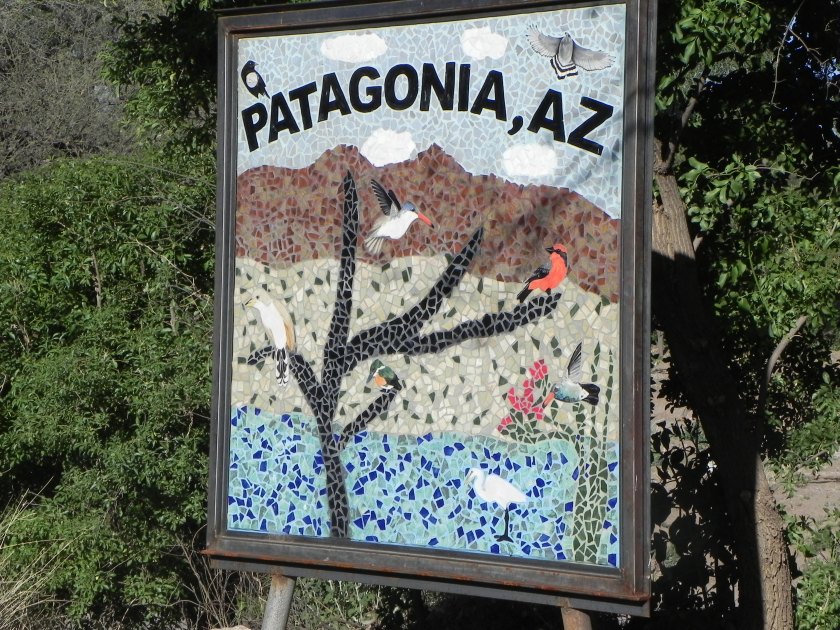
Patagonia SP was  always in our minds as a destination – we had enjoyed birding there the last time we were in the area – so we drove south and checked in.  The laundry was really piling up so the next day we headed out to find a laundromat in Patagonia.  The only trouble was we made a wrong turn coming out of the park and wound up going south instead of north.  Made the most of it and did our wash in Nogales, a populous border town, followed by another good Mexican lunch. On our way back to the park we stopped at Paton Hummingbird Center. It had been a private home, open to the public, until its owners passed away. Through funding by the Tucson Audubon Society and individual donors, the center has become a gem of a park attracting birders from everywhere.  We saw a black-headed grosbeak (a trip bird) five or six species of hummingbirds, lesser goldfinch, many house finches and a few Gambels quail.  The following day we took another guided bird walk along the Sonoita Creek, the source of Patagonia Lake.  John, our guide, knows the area well and we saw many birds including a Townsend’s warbler and cinnamon teal.

After leaving Patagonia we headed for Tucson and searched the cheap camping book for a place to stay.  We decided to take a chance on another county park and it turned out to be a gem. Colossal Cave in Vail, about 20 miles east of Tucson, was up a winding road and had just a couple of graveled sites, marked off by carefully placed rocks and cactus beds.  We ate an early supper and called Jen’s to catch up with family doings.

Early the next morning we heard taps on the van and couldn’t figure out what it could be.  From 6 am until nearly 7, we heard periodic taps and a faint whirring coming from the front of the van.  I had a flashback to our first birding trip to Pokamoke where we saw a cardinal fighting his own reflection in a truck side mirror and just had to get up to investigate.  Sure enough, a bright young male cardinal was landing on our mirror, spotting himself and challenging the “offender” repeatedly by flying against the glass.  He saw me and flew into a nearby shrub, giving me time to fold in the mirrors to protect him from himself. Talk about angry birds, this one was persistent, and continued to fight his reflection in the van windows until we went outside for breakfast.

We left and drove to Saguaro NP, stopping for coffee and a pastry at a craft market outside of Tucson. The park had an 8 mile scenic drive that we took, with pull offs, vistas and a short nature trail. The saguaros are magnificent, reaching 40 feet tall with multiple “arms”.  They grow very slowly, only reaching their full height in about 75 – 100 years.

DSCN1598
Paton’s Hummingbird Center

20180414_061705[1]